Before dawn in Nagano prefecture, a small group of parishioners gathered in silence beside their priest, preparing for a ritual that has shaped winter on Lake Suwa for centuries. They were searching for miwatari — “God’s Crossing” — a ridge of fractured ice once so dependable that its absence would have seemed unthinkable.
The phenomenon appears when the lake freezes solid after several days of temperatures below minus 10 degrees Celsius. As the ice expands and contracts between cold nights and slightly warmer days, cracks open across the surface. Newly frozen shards push upward, forming a raised line that, in Shinto belief, marks the path of a male deity crossing the lake to visit his consort.
This year, as in the past seven winters, the ridge failed to appear.
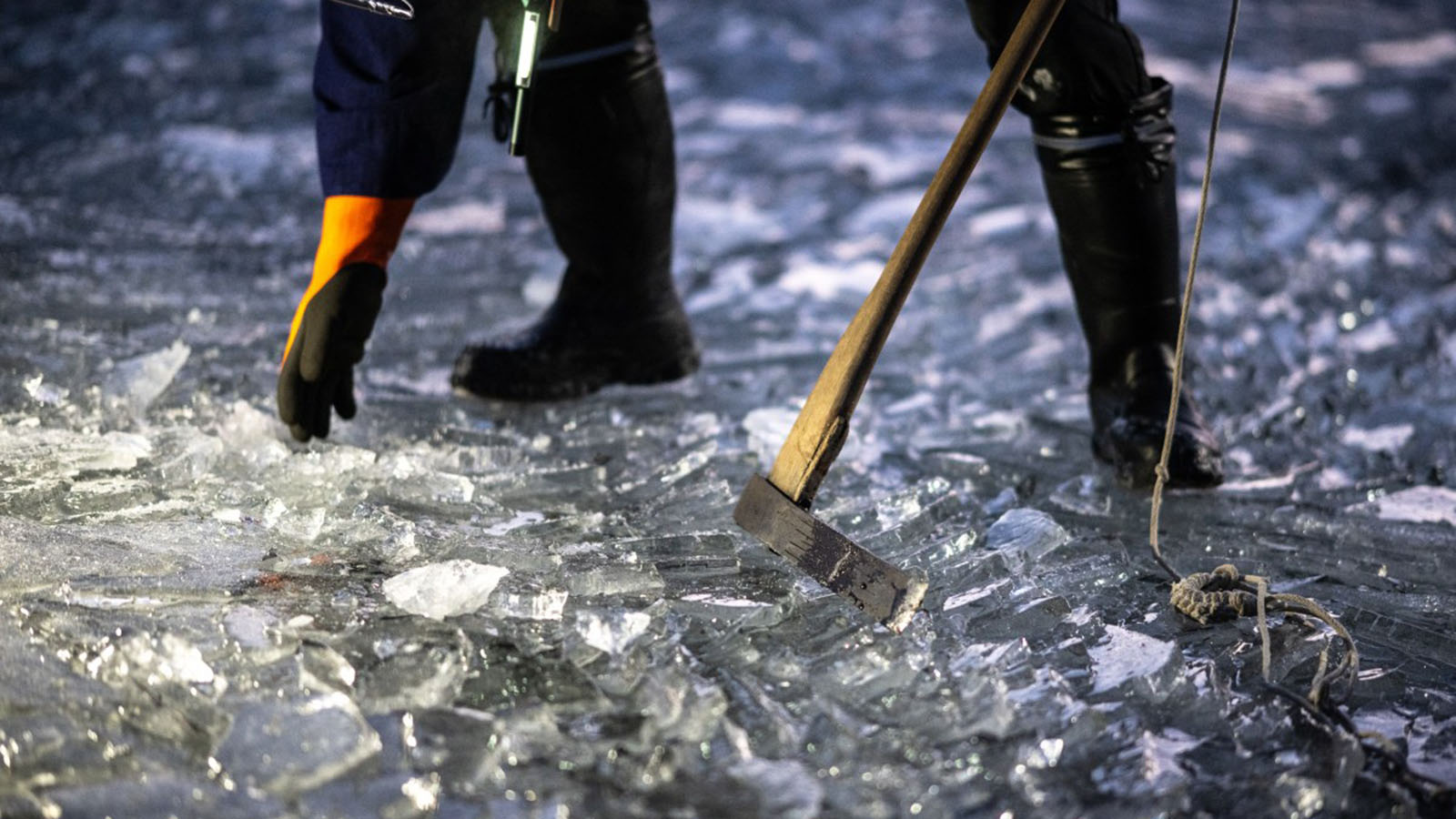
Kiyoshi Miyasaka, a priest at the nearby Yatsurugi Shrine, began the annual watch on January 5. Wrapped in jackets bearing the shrine’s crest, the group approached the water in pre-dawn light. One carried a flag, another an axe used to test the ice. Instead of a frozen surface, they found dark, shifting water.
“How pitiful,” Miyasaka murmured, lowering a thermometer into the lake.
Records of Lake Suwa’s freeze and thaw extend back to 1443, making them among the longest continuous climate observations in the world. Priests of Yatsurugi Shrine formally assumed responsibility for the documentation in 1683. Over time, simple notes on whether the lake froze evolved into systematic records of ice thickness and temperature.
Naoko Hasegawa, a geographer at Ochanomizu University, describes the archive as unique: centuries of observations from a single fixed location. For climate historians, it offers a rare window into past winters long before modern meteorology.
The data show a clear shift. Until the 1980s, miwatari appeared almost every winter. Since then, full freezes have become sporadic. Morning temperatures increasingly fail to dip low enough for the lake to seal over. Takehiko Mikami, a professor emeritus at Tokyo Metropolitan University who has studied the records, recalls walking across 15 centimetres of ice in 1998. Such winters are now exceptional.
In late January, there was a brief moment of hope. After weeks of sub-zero mornings, the lake froze completely. Parishioners smiled as a block of ice was cut and measured. Within days, however, the surface melted before the ridge could form.
On February 4, Miyasaka declared an “open sea” — ake no umi — signalling that no crossing would appear this season. It marked eight consecutive years without the phenomenon, equalling the longest recorded absence, in the early 16th century. Mikami doubts the completeness of those earlier records and believes the current gap may be unprecedented.
For believers, the disappearance carries spiritual weight. For scientists, it confirms a pattern consistent with broader warming trends. “Nature doesn’t lie,” Miyasaka said.
When miwatari forms, the priest conducts a ritual directly on the ice. In more than four decades in his role, Miyasaka has performed that ceremony only 11 times. Yet he continues the watch each winter, adding another entry to a chronicle that now serves as both sacred record and climate ledger.
“If the trend continues,” Mikami warns, “we may never see the miwatari again.”