
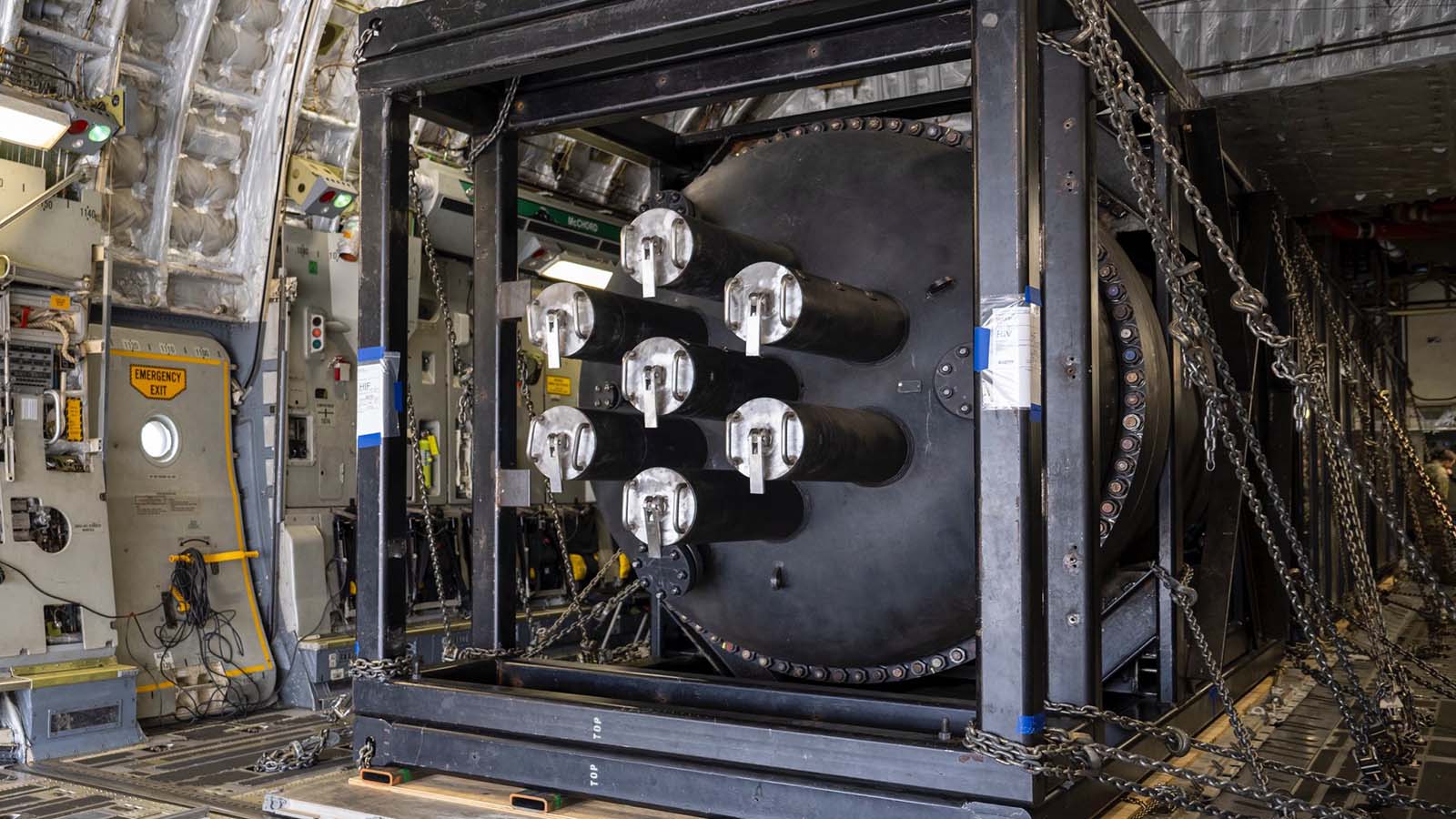
The United States has transported a small nuclear reactor by military cargo aircraft for the first time, in what officials describe as a proof of concept for rapid deployment of nuclear power to military or remote civilian sites.
The Departments of Energy and Defense partnered with California-based Valar Atomics to fly a Ward microreactor — without nuclear fuel — aboard a C-17 aircraft from California to Hill Air Force Base in Utah. Energy Secretary Chris Wright and Defense Under Secretary for Acquisition and Sustainment Michael Duffey were on board during the flight.
Officials framed the exercise as both a logistical demonstration and a strategic signal. Duffey said the capability would help ensure nuclear power could be deployed “when and where it is needed” to support U.S. forces.
The initiative aligns with President Donald Trump’s broader push to expand domestic nuclear energy. Last May, Trump signed four executive orders aimed at accelerating nuclear deployment, arguing that increased energy production is essential for national security and for meeting the growing electricity demands of artificial intelligence and advanced manufacturing.
The Energy Department has also issued grants to support development of small modular reactors and related technologies.
Microreactors — typically designed to generate between one and several megawatts of electricity — are promoted as flexible power sources for remote bases, disaster zones or isolated communities. Advocates argue they offer a more durable alternative to diesel generators, which depend on vulnerable fuel supply chains.
Valar’s Ward reactor, slightly larger than a minivan, is designed to generate up to five megawatts at full capacity — enough, the company says, to power roughly 5,000 homes. It is expected to begin operating in July at 100 kilowatts, scaling up to 250 kilowatts later this year before eventually reaching full output. The company hopes to begin limited commercial power sales in 2027 and move toward full commercialisation by 2028.
Federal support remains critical. While private firms fund reactor design and construction, they depend on government action for fuel fabrication, uranium enrichment and regulatory approvals. Fuel for Valar’s reactor is expected to be transported from the Nevada National Security Site to a facility in Utah, according to Wright.
The demonstration also highlights unresolved questions around cost and waste. Critics argue that small reactors have yet to prove they can generate electricity competitively. Edwin Lyman, director of nuclear power safety at the Union of Concerned Scientists, said microreactors could produce electricity at a higher cost than large conventional nuclear plants or renewable sources such as wind and solar.
Radioactive waste remains another challenge. Even compact reactors generate spent fuel requiring long-term management. While the Energy Department is in discussions with several states, including Utah, about hosting facilities for fuel reprocessing or disposal, no permanent national repository has been established.
The airlift test illustrates the Pentagon’s interest in distributed energy resilience. For the military, portable nuclear power could reduce dependence on fuel convoys in contested environments. For policymakers, it represents part of a broader strategy to reassert U.S. leadership in advanced nuclear technology.
Whether microreactors become a cornerstone of future energy systems will depend not only on engineering success, but on economics, regulatory clarity and public acceptance.