Revolutions make sense only in retrospect. Once a government has fallen, historians can spend decades cataloguing the inequality, corruption and repression that made collapse inevitable. What almost never survives that retrospective tidying is the sheer disproportion between the spark and the fire — the fact that the precipitating event is so often trivial next to the grievances it detonates.
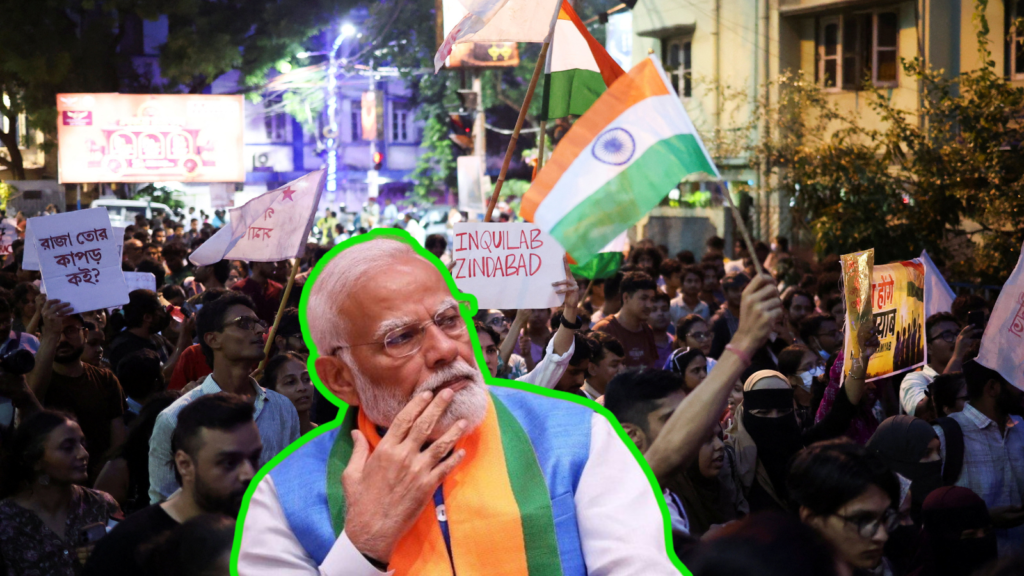
South Asia has spent the past two years supplying fresh case studies. Bangladesh’s government fell in 2024 over a job quota that, on close inspection, affected a strikingly small number of actual appointments. Nepal’s government fell in 2025 over a ban on 26 social media apps that lasted less than a week. And this year, India came closer than at any point in Narendra Modi’s eleven years in office to a comparable youth revolt — this one detonated by a Supreme Court justice’s stray insult during a hearing on unemployment. In each case, the state’s response to the initial spark did more to inflame the crisis than the spark itself.
Bangladesh: a quota measured in hundreds, a movement measured in millions
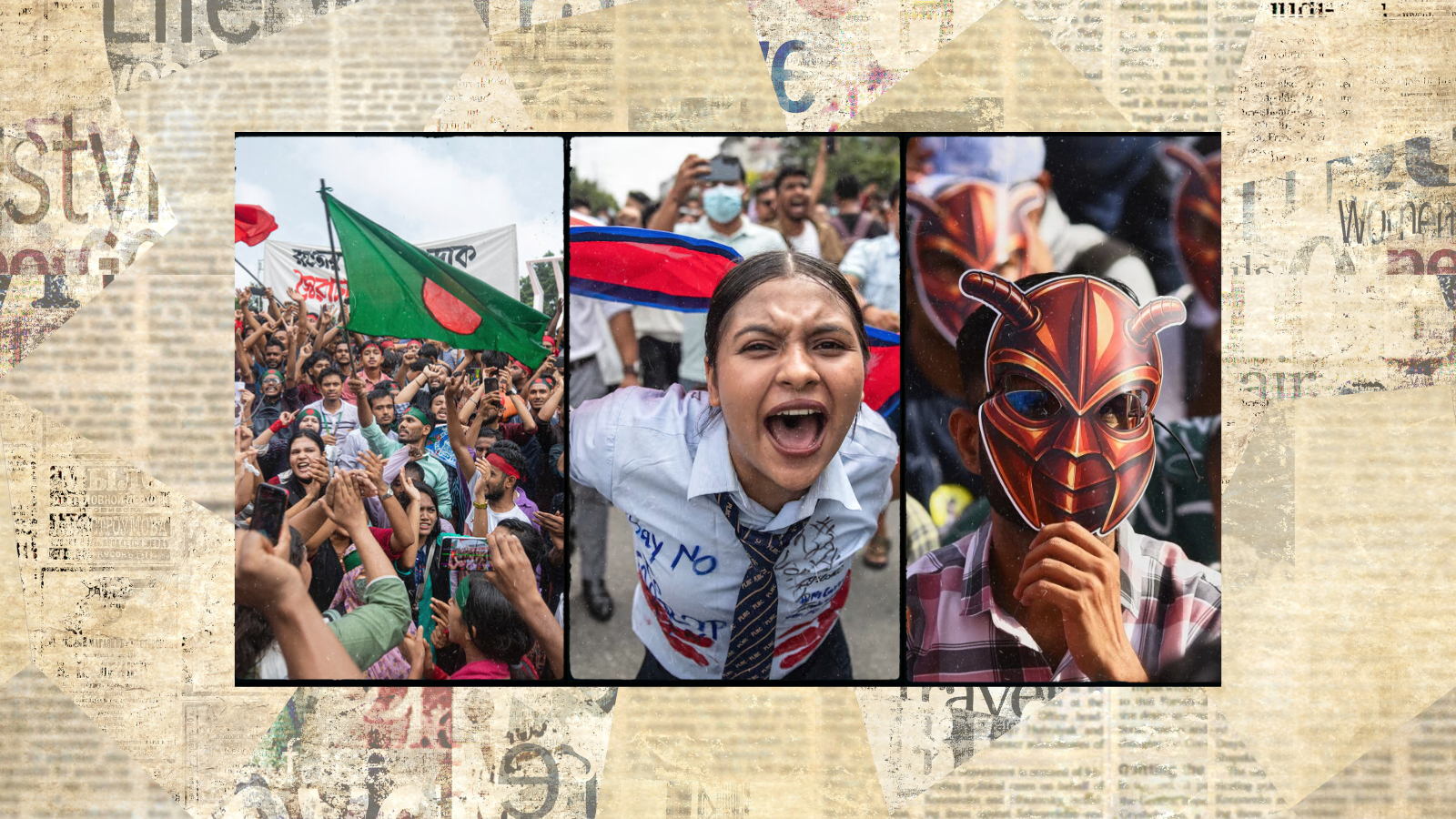
The numbers behind Bangladesh’s 2024 uprising are worth dwelling on precisely because they are so unimpressive next to what followed. The country’s civil service quota system reserved 30 percent of first- and second-class government jobs for the children and grandchildren of veterans of the 1971 liberation war, part of a wider 56 percent quota bloc that also covered women, underrepresented districts, ethnic minorities and people with disabilities, leaving 44 percent of posts allocated purely on merit — a split that had been in place since the merit-based share was raised in stages from 20 percent in the early 1970s, according to the Vivekananda International Foundation’s review of the quota’s history. By the time of the protests, Bangladesh Civil Service exam data compiled by the Dhaka Tribune showed the freedom-fighter quota was being filled at a fraction of its allotted share — around 9 percent of successful candidates in the 35th BCS exam, 8.99 percent in the 36th, and similar single-digit figures in the cycles that followed — against total vacancies that, per figures reported by The Independent, numbered in the low thousands per cycle: 1,803 posts in the 35th BCS, 1,226 in the 37th. Do the arithmetic and the freedom-fighter quota was translating into something on the order of a few hundred actual jobs a year, in a country of roughly 170 million people.
That was the fuse. What it lit was a movement that, by the time it was finished, had forced Prime Minister Sheikh Hasina to flee the country by helicopter after fifteen years in power. The trigger was a June 2024 High Court ruling that reinstated the quota system after it had been suspended in 2018, following a challenge brought by seven children of freedom fighters; the court declared the 2018 cancellation illegal on June 5, as detailed in an ISAS brief by South Asia analyst Tariq Karim. Students treated the ruling as confirmation that merit no longer mattered in a system already widely seen as a patronage machine for the ruling Awami League. Protests escalated through July into nationwide clashes; by the time Bangladesh’s Supreme Court intervened on July 21 — cutting the quota to 7 percent and setting merit-based recruitment at 93 percent — at least 151 people had already been killed, according to an AFP tally reported by Gulf News. That figure would climb considerably as the movement’s demands broadened from quota reform into an outright rejection of Hasina’s government; retrospective accounts of the full uprising put the eventual death toll anywhere from roughly 650 to over 1,000. The court’s concession, like so many “too little, too late” gestures by embattled governments, could not undo the damage; five days later, Hasina resigned.
Nepal: a ban lifted in a day, a government gone in two
If Bangladesh shows how a narrow bureaucratic dispute can metastasize, Nepal shows how quickly a state’s own overreaction can compress that process into days rather than months. On September 4, 2025, Kathmandu ordered the suspension of 26 social media platforms — including Facebook, Instagram, YouTube and X — officially for their failure to register under new communications regulations, a move officials framed as a compliance issue but which, as The Business Standard later reported, Nepal’s youth read as an attempt to choke off the platforms they used to organise, work and speak. The ban was less the cause of unrest than the accelerant for grievances that had been building for years: chronic corruption, a governing class that had rotated through the same handful of leaders for two decades, and a viral social-media trend exposing the conspicuously lavish lifestyles of politicians’ children — the so-called “nepo kids.”
The state’s response turned a protest into an uprising. Police opened fire on demonstrators outside parliament on September 8, killing 19 people, NPR reported, and within a day protesters had stormed the prime minister’s private residence and set it ablaze along with the homes of other senior ministers. Prime Minister K.P. Sharma Oli resigned on September 9, a single day after the ban he had imposed was lifted. By the time the unrest subsided, the toll had risen further: Britannica’s account of the crisis put the count at 74 dead and more than 2,113 injured by September 22. In a detail that captured the movement’s improvised, digitally native character, thousands of young Nepalis — including members of the diaspora — selected an interim prime minister not through a physical or electoral ballot but through an online poll conducted on Discord, a platform built for gamers, as Al Jazeera reported at the time, ultimately elevating a governing arrangement aligned with former Kathmandu mayor Balen Shah’s supporters and steering the country toward fresh elections.
India: from a judge’s insult to a minister’s resignation
India’s version of the story began not with a policy but with a put-down. During a court hearing on unemployment, India’s chief justice compared jobless young people to cockroaches — a remark that, PBS NewsHour reported, sparked the founding of the satirical Cockroach Janta Party, or CJP, by Abhijeet Dipke, a graduate student at Boston University. The insult landed on already-raw nerves: India’s National Eligibility cum Entrance Test, the gateway exam for undergraduate medical admissions, had been voided earlier in the year after investigators found its questions had leaked, forcing more than two million students to retake a stressful and costly exam, according to Time. It was, by one count, part of a much longer pattern — a dataset tracking exam paper leaks between 2004 and 2026, compiled by the German Institute for Global and Area Studies (GIGA), recorded 110 major incidents affecting more than 22.5 million candidates, with the overwhelming majority occurring after the current government took office in 2014.
What followed was less a single uprising than a slow-burning campaign: weeks of marches, a hunger strike, and repeated clashes with police that activists linked to at least 20 student suicides tied to the exam-leak fallout, according to Times of India reporting cited by PBS. Protesters, adopting the “cockroach” label as a badge rather than an insult, marched on Parliament and on the prime minister’s residence, where opposition leader Rahul Gandhi was briefly detained during a demonstration in solidarity with the movement, Time reported. The government initially tried outreach without concession — NPR reported that Health Minister J.P. Nadda met briefly with CJP spokespeople, while Education Minister Dharmendra Pradhan refused to step down — but the pressure held. Pradhan ultimately resigned in late July 2026, roughly seven weeks after the protests began, PBS reported, and the CJP declared its core demands met and stood down its campaign.
The common thread: a generational dissonance the state can’t bridge
Analysts studying the three episodes together point less to any single institutional failure than to a generational mismatch that none of these governments have found a way to close. Paul Staniland, an associate professor of political science at the University of Chicago who studies political violence in South Asia, told Al Jazeera the pattern amounts to a genuinely new politics of instability in a region that has historically seen political conflict expressed through other means, such as military coups, rather than the wholesale overthrow of governments by protest. Meenakshi Ganguly, deputy Asia director at Human Rights Watch, traced the anger to an accumulation of unaddressed socioeconomic grievance colliding with leadership that is, quite literally, a generation removed from the people it governs — noting to Al Jazeera that Nepal’s Oli, Bangladesh’s Hasina and Sri Lanka’s Rajapaksa were all in their seventies when their governments fell, leaving young populations unable to find any point of connection with their political leadership. Rumela Sen of Columbia University framed the underlying demand as fundamentally democratic rather than nihilistic, telling Al Jazeera it reflects a sincere aspiration for political inclusion and economic justice from a generation that has become adept at using digital platforms for organising and self-expression.
That digital fluency is itself part of the story. Each of these movements weaponized the same tools states tried to restrict or ignore: Nepal’s organizers used Discord and Instagram after the ban; India’s “cockroach” movement metabolized a courtroom insult into a meme, a party name and a mobilization within days; Bangladesh’s 2024 protesters relied on encrypted channels once the government cut mobile internet nationwide. Political anthropologist Jeevan Sharma has argued the movements are also learning from one another in real time, telling Al Jazeera that Nepali youth had been closely watching the uprisings in Sri Lanka and Bangladesh before their own crisis erupted — a diffusion effect that predates this cluster of protests. Sri Lanka’s 2022 “Aragalaya,” which forced President Gotabaya Rajapaksa to flee the country amid an economic collapse marked by twelve-hour power blackouts, mile-long fuel queues and inflation above 50 percent, is widely treated by regional analysts as the template the later movements consciously or unconsciously followed.
Governance after the fire
What distinguishes this cluster of uprisings from history’s more chaotic revolutionary moments is how quickly each society has tried to route the anger back into formal politics — with mixed results. Bangladesh and Nepal both went to the polls in the first months of 2026, and the outcomes diverged sharply. Bangladesh’s election, per the South China Morning Post, returned the pre-existing political establishment, with the Bangladesh Nationalist Party under Tarique Rahman regaining power — a result that has left some participants in the original uprising uneasy about how much actually changed. Nepal took the opposite path, with voters largely rejecting the old guard, though the country’s stability now hinges on whether a governing coalition built around outsiders can deliver on the anti-corruption promises that fueled the uprising in the first place. India’s episode, unlike the other two, produced no change of government at all — only a single ministerial resignation — though regional commentators argue it has left Modi’s political standing measurably diminished heading into a period of heightened economic anxiety among young voters.
The lesson these episodes offer state institutions is a familiar one, stated far too late by nearly every government it applies to: address grievances while they are still small enough to be addressed, because by the time a state notices the fire, the fuse has usually burned all the way down. Judicial or executive concessions offered under duress — Bangladesh’s court-ordered quota cut, Nepal’s reversal of its social media ban within a day — rarely arrive in time to prevent the casualties that follow. And in every case examined here, it was not the original grievance but the state’s use of force against protesters that transformed a policy dispute into an existential crisis for the government in power. For a region now watching each of its neighbors go through this cycle in close succession, that ought to be the more legible warning: overreaction, not the initial demand, is what tends to write the ending.