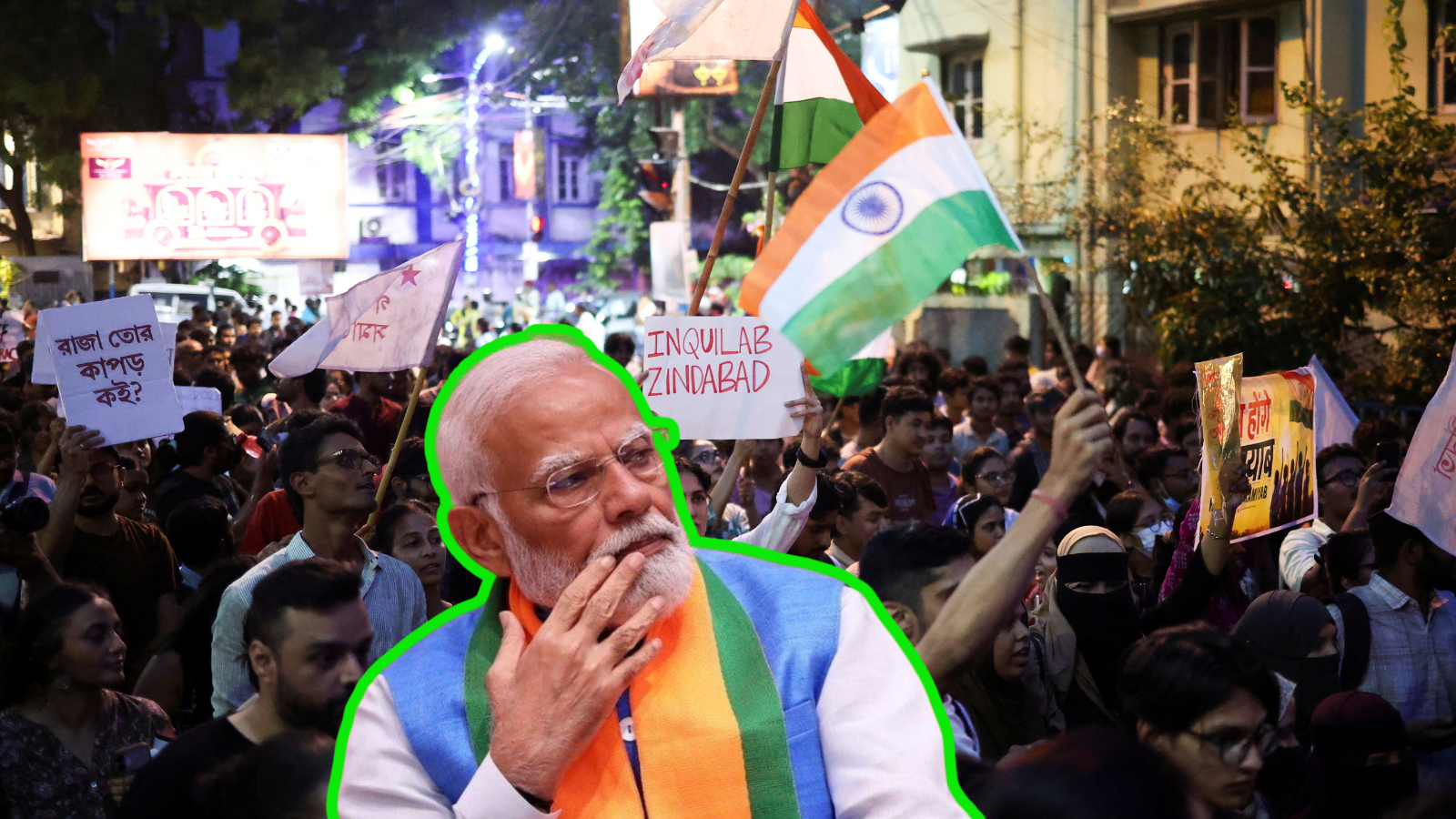
The resignation of India’s education minister, Dharmendra Pradhan, on Saturday closes out a five-week standoff between the government and a youth-led protest movement — but it opens up a far larger question about who actually holds political leverage in the world’s most populous democracy. For a prime minister who has spent a decade cultivating an image of unshakable authority, the concession is not simply a policy reversal. It is evidence that a demographic Narendra Modi’s government has struggled to read is starting to organize outside the channels his party has mastered.
A Movement Without a Party
The Cockroach Janta Party, or CJP, is not registered as a political organization and has made no formal decision about contesting elections. Yet within weeks of its founding, it built an Instagram following of 22 million — more than double what the ruling Bharatiya Janata Party has accumulated over years of dedicated digital campaigning. That asymmetry is the crux of the story. The protest was triggered by a leaked medical-entrance exam, but analysts describe the paper leak as a proximate cause layered atop deeper anxieties: youth unemployment, and a growing fear that automation and AI could hollow out the outsourcing and IT-services jobs that have anchored India’s white-collar economy.
Political analyst Amitabh Tiwari frames the exam leak as a spark rather than the fire itself, pointing instead to accumulated frustration among young Indians who see few institutional outlets for their grievances. That framing matters because it suggests the CJP’s momentum is not tied to a single grievance that fades once addressed — the minister is gone, but the conditions that produced the anger remain.
The Demographic Math Behind the Discontent
Underlying the protests is a structural mismatch that Indian politics has largely avoided confronting. Indians between 18 and 40 make up an estimated 40% of the population but hold only about 10% of seats in the lower house of parliament — a share that has fallen by more than half since the 1950s, according to Tiwari. The average age of Modi’s cabinet exceeds 60. In a country where the political class skews older even as the population skews dramatically younger, the CJP’s emergence functions as a proxy for a representation gap that conventional party politics has not addressed.
This gap has been compounded by a shift in where political conversation actually happens. Author Anurag Minus Verma noted that the BJP’s digital strategy was built around X, where political discourse has traditionally concentrated — but that conversation, he argues, has moved decisively to Instagram, especially among younger users. Columnist Santosh Desai went further, arguing that Instagram rewards a kind of unvarnished authenticity that the BJP’s traditionally polished messaging apparatus is not built to produce, describing the platform as one shaped by a generation with little patience for “pre-laboured” political communication.
A Break From Precedent
What makes the minister’s resignation notable is less the act itself than the pattern it interrupts. Modi’s government has historically resisted backing down under public pressure — most notably during the farmers’ protests, which ran for nearly a year before the 2021 repeal of contentious agricultural laws. That the CJP secured a ministerial resignation in five weeks, without formal political structure, suggests either a shift in the government’s political calculation or a recognition that the coalition of people in the streets was broader and more difficult to dismiss than typical opposition-mobilized demonstrations.
Anthropologist Sanjay Srivastava of SOAS University of London points to this breadth as the more consequential outcome: many of the protesters, he suggests, may be Modi supporters themselves, marking a departure from opposition-driven protest movements and indicating a widening willingness — even among the BJP’s own base — to question whether the ruling party’s direction serves the country’s interests.
The Electoral Stakes Ahead
The immediate political test will arrive in next year’s state elections in Uttar Pradesh, Punjab, and Gujarat — the first two being among India’s most politically significant states, and Gujarat being Modi’s home turf and a BJP stronghold. A longer-term and more structural risk hangs over the 2029 national election, contingent on whether the CJP’s founder, Abhijeet Dipke, moves the movement into formal electoral politics — a decision he has not yet made.
There is precedent elsewhere in India for youth-driven, digitally native political mobilization translating into electoral power: an actor-turned-politician recently won the chief minister’s post in Tamil Nadu on the strength of an Instagram-first youth base, running independently while allied with opposition parties. Analysts caution that young Indian voters have historically voted along religious and caste lines — a pattern that has generally favored the BJP’s Hindu nationalist platform — but the CJP episode, alongside the Tamil Nadu result, suggests that pattern may be loosening.
The Politics of Listening
Rajnath Singh, one of Modi’s senior ministers, framed the government’s response as a matter of listening to “genuine concerns” — a notable rhetorical shift for an administration built on projecting decisiveness rather than responsiveness. Tiwari suggests that shift may be more than rhetorical: a leader who listens, he argues, is now likely to fare better politically than one who does not, and that recalibration is what Modi is now attempting to demonstrate.
Whether that recalibration is durable or merely tactical will likely be tested well before any national election. The CJP has not said whether it intends to become a political party, and its influence may prove as fluid as the platform that built it. But the episode has already established something harder to reverse: a demonstrated willingness among a demographic long assumed to be politically passive — or reliably loyal — to organize rapidly, visibly, and outside the government’s preferred channels of engagement. For a government whose authority has rested substantially on the appearance of control, that alone represents a meaningful erosion.